

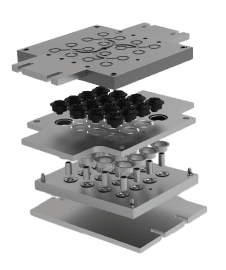
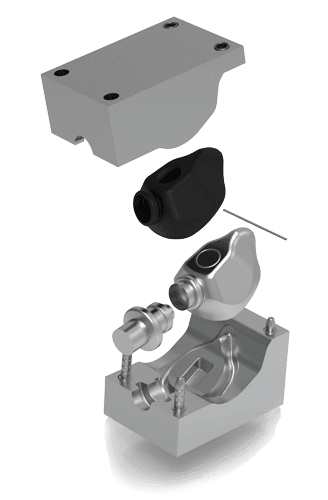




Rubber press
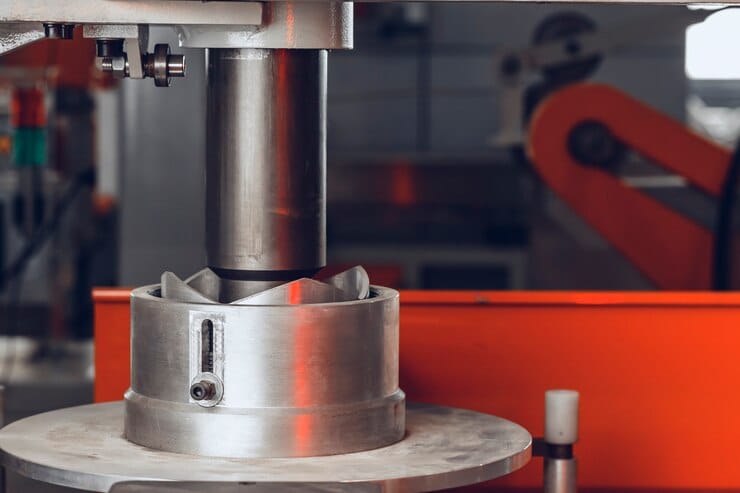
Hydraulic press
آبان 8, 1404
also available in:

Contents
What is a rubber press and what are its industrial applications?
A rubber press is one of the most important pieces of equipment in the process of producing rubber parts; its main role is shaping, compacting, and curing rubber in industrial molds. This machine uses controlled pressure and heat to compress rubber material into a dedicated mold, producing a precise, durable, and homogeneous part.
Across various industries—from automotive to oil & gas and medical equipment—the rubber press is the foundation for producing many critical parts that require high durability and resistance to harsh conditions.
How does a rubber press operate?
In the rubber pressing process, raw rubber material is placed inside the mold and the machine applies high pressure and appropriate heat to form the final shape.
Three essential factors play a role at this stage:
- Pressure: The mechanical or hydraulic force that compresses the rubber inside the mold.
- Temperature: The heat level that ensures complete curing of the rubber and stabilizes the final shape.
- Cure Time: The duration the material must remain under pressure and temperature to reach the desired quality.
The correct combination of these three factors produces a precise part with high strength and no surface defects.
Types of rubber press machines
In the mold-making industry, three main types of rubber presses are used, each designed for a specific purpose:
1. Compression Molding
In this method, rubber material in sheets or pieces is placed into a heated mold and, after closing the mold, is cured under high pressure. This method is suitable for parts with large dimensions or great thickness.
2. Transfer Molding
In transfer molding, raw material is first heated in a separate chamber and then injected into the mold. This method offers higher dimensional accuracy and is used for producing complex and delicate parts.
3. Injection Molding
In this method, molten rubber is injected directly into the mold under high pressure. Production speed in this system is very high and it is suitable for mass production of industrial parts.
The company Parto Gostar Sepahan (PGS Mold) leverages modern equipment and a specialized technical team to design and manufacture all three types of molds and rubber press machines to meet the needs of various industries.
Advantages of using a rubber press machine
Rubber press machines offer many advantages over traditional manufacturing methods for parts, including:
- High dimensional accuracy: Parts produced with minimal error and tolerance.
- Increased strength: The rubber’s molecular structure becomes more cohesive under pressure and heat.
- Mass production with uniform quality: Suitable for producing series of identical parts with consistent quality.
- Raw material savings: Due to precise control of material flow into the mold.
- Reduced maintenance costs: Produced parts are highly durable and wear out more slowly.
Applications of rubber presses across industries
When it comes to producing durable, flexible, and precise parts, the rubber press plays an undeniable role in industry. It may be interesting to know that more than 70% of rubber parts used across industries are manufactured using press machines. This technology enables the production of parts that withstand pressure, heat, abrasion, and chemicals.
Below are the main industries that use presses:
🔧 1. Automotive Industry: the beating heart of rubber press use
In automotive manufacturing there are thousands of small and large rubber parts, each playing a key role in vehicle safety and performance.
Rubber presses are used in this industry to produce parts such as O-rings, bushings, gaskets, bump stops, dust boots, engine mounts, and door seals.
These parts not only prevent dust and moisture ingress but also help reduce noise and vibration.
Thanks to modern molding technologies, companies like Parto Gostar Sepahan (PGS Mold) have been able to produce high-precision, long-lasting parts for domestic and international automakers.
🛢️ 2. Oil, Gas and Petrochemical Industries: resistance to pressure and heat
In oil and gas facilities, rubber parts must operate under very harsh conditions — high temperatures, high pressure, and contact with corrosive substances.
Rubber presses in this field are used to manufacture packings, sealing O-rings, diaphragms, and thermal insulators.
If these parts are not manufactured correctly, they can lead to fluid leaks and heavy damage.
Therefore, mold quality and the pressing process are of special importance, and companies like PGS Mold ensure industrial equipment safety by designing robust molds.
🚆 3. Rail and Mining Industries: vibration absorption and impact resistance
In railways and mines, equipment is exposed to heavy impacts and constant vibrations.
Rubber presses in this sector are used to produce bumpers, anti-vibration mounts, rubber shock absorbers, and flexible couplings.
These parts increase equipment life and provide safer and smoother machine operation.
In mining, wear-resistant rubber plays a crucial role in the safe transport of mined materials.
⚡ 4. Electrical and Electronics Industries: reliable and precise insulation
Rubber parts produced by presses in the electrical industry are used for electrical insulation, preventing leakage currents, and protecting windings and connectors.
Due to their high dielectric properties and heat resistance, silicone and EPDM rubbers are the best choices for these applications.
The pressing process ensures these parts are completely uniform and bubble-free, which is critical for electrical safety.
🧪 5. Medical and Healthcare Industries: cleanliness and safety first
In the medical field, every part must be clean, non-toxic, and chemically resistant.
Rubber presses are used to manufacture silicone gaskets, sterile caps, fluid transfer pump components, and specialized medical tubing.
Here, precision and process control in pressing are extremely important; the smallest defect can affect the end user’s health.
For this reason, leading companies like Parto Gostar Sepahan use precision molds and medical-grade materials to meet hygiene standards.
⚙️ 6. Construction and Civil Engineering: durability in tough environmental conditions
In construction projects, pressed rubber is used to make sealing strips, bearing pads under structures, and vibration-damping connectors.
These parts, being highly resistant to moisture, temperature, and pressure, extend the lifespan of structures.
Rubber pressing in this area helps produce parts with uniform thickness and excellent adhesion.
✈️ 7. Aerospace and Defense: the highest level of precision
In aerospace industries, the smallest error can be costly and dangerous.
Rubber parts used in this sector — such as engine seals, vibration isolators, and diaphragms — are manufactured by rubber presses to achieve micron-level precision and high thermal stability.
Companies like Parto Gostar Sepahan, by designing precise CNC molds, have managed to produce parts that retain performance even under high pressure and temperature conditions.
Technical considerations in rubber press mold design
To achieve an ideal result, mold design for a rubber press is of special importance. In mold design, factors such as the type of rubber, curing temperature, part thickness, and shrinkage rate must be calculated precisely.
The company Parto Gostar Sepahan uses specialized 3D design software and advanced CNC machines to produce molds with micron-level accuracy, which leads to improved quality and longer lifespan of the final part.
Hydraulic rubber press machines
One of the most commonly used types of press machines is the hydraulic rubber press. These machines use hydraulic systems to create uniform pressure and allow precise control of temperature and pressure.
Modern hydraulic presses are equipped with PLCs and digital displays that enable accurate adjustment of cure time, temperature, and pressing force.
Quality control in the rubber pressing process
In industrial production, quality control plays a crucial role. Every rubber part must be inspected for dimensions, weight, adhesion, and surface appearance.
The company Parto Gostar Sepahan (PGS Mold), relying on international standards and precise measuring equipment, ensures that produced products are delivered to customers with the highest quality.
Conclusion
The rubber press is the junction between materials science and manufacturing engineering. Without this technology, producing durable and precise rubber parts would not be possible.
From small automotive parts to massive seals in petrochemical industries, everything depends on the quality of pressing.
If you are looking to produce precise, durable, and cost-effective rubber parts, choosing a modern rubber press and specialized mold-making is the best approach — and Parto Gostar Sepahan is ready to facilitate this path for you with its technical knowledge and experience.
Frequently Asked Questions About Rubber Presses
A rubber press is a machine that uses pressure and heat to compress rubber material inside a mold and form it into the desired shape. This process is widely used in producing industrial parts such as O-rings, bushings, bumpers, and gaskets.
There are three main types of rubber press machines: Compression, Transfer, and Injection. Each is selected based on the part type, production volume, and required precision.
In rubber pressing, raw material is compressed in the mold and then cured, while in injection molding the melted material is forced into the mold under pressure. Injection molding is faster and more precise for mass production.
Rubber presses are used in automotive, oil & gas, petrochemical, rail, medical, electrical, and even aerospace industries. Any industry requiring durable and flexible parts benefits from this technology.
This machine enables production of parts with high accuracy, great durability, uniform quality, material savings, and reduced maintenance costs.
The press mold determines the final shape, dimensions, and quality of the part. Precise mold design reduces waste and extends production life. Parto Gostar Sepahan provides optimal results through accurate mold design.
Yes, modern rubber press machines feature digital controls for adjusting pressure, temperature, and cure time. Therefore, they can be configured to produce a wide variety of parts with different thicknesses and materials.